Description
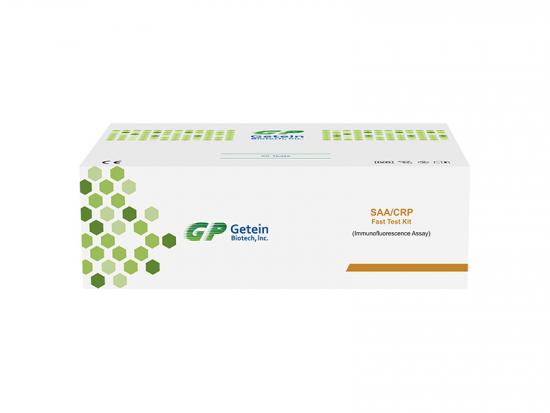
SAA/CRP Fast Test Kit (Immunofluorescence Assay)
The SAA/CRP Fast Test Kit is a quantitative immunofluorescence assay designed to measure Serum Amyloid A (SAA) and C-reactive protein (CRP) in serum, plasma, whole blood, or fingertip blood. This dual-marker test supports the early detection of infection and inflammation, helping clinicians distinguish between bacterial and viral infections with enhanced sensitivity.
Key Advantages
- Dual Biomarker Detection: Measures both SAA and CRP for comprehensive inflammation profiling
- Rapid Results: Delivers results in just 5 minutes
- Improved Sensitivity: SAA is more responsive in viral infections than CRP alone
- Wide Sample Compatibility: Compatible with serum, plasma, whole blood, and fingertip blood
- Stable Storage: 4–30°C with a 24-month shelf life
About SAA/CRP
Serum Amyloid A (SAA) and C-reactive protein (CRP) are acute-phase proteins that rise significantly during infection, inflammation, or tissue injury. SAA is highly sensitive to viral infections and transplant rejection, while CRP is widely used to monitor bacterial infections and inflammation. Together, they enhance diagnostic precision, particularly in neonatal sepsis, cardiovascular risk assessment, and post-surgical monitoring.
Specifications
| Parameter | Details |
|---|---|
| Test Item | SAA/CRP |
| Sample Type | Serum, Plasma, Whole Blood, Fingertip Blood |
| Detection Method | Immunofluorescence Assay |
| Detection Range | SAA: 5.0–200.0 mg/L CRP: 0.5–200.0 mg/L |
| Cut-off Value | SAA: 10.0 mg/L CRP: 10.0 mg/L |
| Test Time | 5 Minutes |
| Storage Conditions | 4–30°C |
| Shelf Life | 24 Months |
Compatible Devices
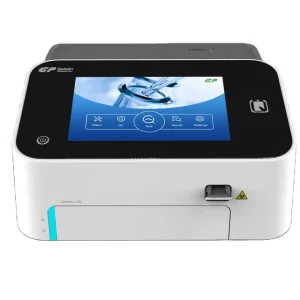
- Getein 1100 Immunofluorescence Quantitative Analyzer
- Getein 1600 Immunofluorescence Quantitative Analyzer
Clinical Applications
- Sensitive detection of infection and inflammation
- Differentiation of bacterial vs. viral infections
- Monitoring of trauma and surgical recovery
- Prognostic support in cardiovascular diseases
- Antibiotic treatment guidance