Description
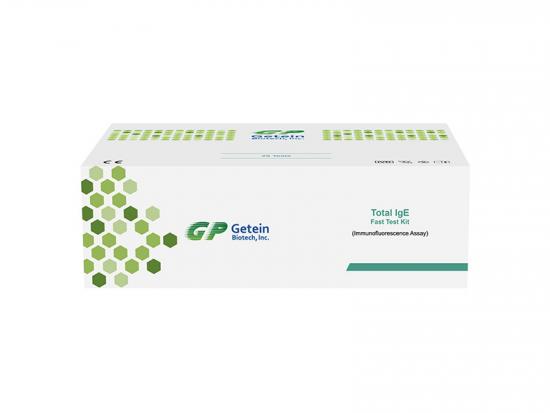
Total IgE Fast Test Kit (Immunofluorescence Assay)
The Total IgE Fast Test Kit is a quantitative immunofluorescence assay designed for measuring total immunoglobulin E (IgE) levels in serum, plasma, or whole blood. It serves as an aid in diagnosing IgE-mediated allergic disorders when used in conjunction with clinical findings.
Key Advantages
- Comprehensive Allergy Assessment: Quantifies total IgE to support diagnosis of atopic conditions
- Rapid Testing: Delivers accurate results within 15 minutes
- Broad Sample Compatibility: Works with serum, plasma, and whole blood
- Wide Measurement Range: 1.00–2000.00 IU/mL
- Stable Storage: Store between 4–30°C with 24-month shelf life
About IgE
IgE is an immunoglobulin produced by plasma cells and plays a central role in allergic reactions. It binds to mast cells and basophils, triggering histamine release upon exposure to allergens. Elevated total IgE levels may indicate conditions like allergic rhinitis, asthma, or dermatitis. In some cases, parasitic infections may also lead to increased IgE due to immune system activation. Measuring IgE provides insight into allergic sensitivity and supports clinical evaluation.
Specifications
| Parameter | Details |
|---|---|
| Test Item | Total IgE |
| Sample Types | Serum, Plasma, Whole Blood |
| Detection Method | Immunofluorescence Assay |
| Detection Range | 1.00–2000.00 IU/mL |
| Cut-off Value | 1.00–165.00 IU/mL |
| Test Time | 15 Minutes |
| Storage Conditions | 4–30°C |
| Shelf Life | 24 Months |
Compatible Devices
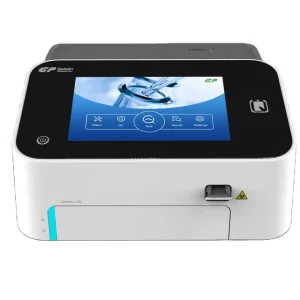
- Getein 1100 Immunofluorescence Quantitative Analyzer
- Getein 1180 Immunofluorescence Quantitative Analyzer
- Getein 1600 Immunofluorescence Quantitative Analyzer
Clinical Applications
- Diagnosis of IgE-mediated allergic conditions
- Evaluation of atopic disorders including asthma and dermatitis
- Monitoring allergic sensitization over time