Description
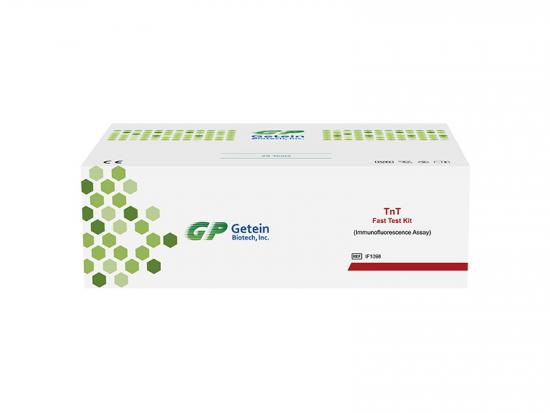
TnT Fast Test Kit (Immunofluorescence Assay)
The TnT Fast Test Kit by Getein is a quantitative immunofluorescence assay for the rapid detection of cardiac Troponin T (TnT) in serum, plasma, or whole blood samples. This test is crucial in the early screening and diagnosis of acute myocardial infarction (AMI), heart failure, unstable angina, myocarditis, and myocardial injury, and is also used in risk stratification and postoperative monitoring.
Key Advantages
- Broad Clinical Utility: Ideal for diagnosing a range of cardiac events including AMI and heart failure
- High Sensitivity: Cut-off value at 14.0 pg/mL
- Wide Detection Range: 10.0–10,000.0 pg/mL
- Flexible Sample Types: Compatible with serum, plasma, and whole blood
- Stable Storage: 4–30°C with 24 months shelf life
About TnT
Cardiac Troponin T (TnT), a regulatory protein of striated muscle contraction, is highly specific to myocardial tissue. With a molecular weight of 39.7 kDa, TnT is released into circulation during cardiac muscle injury. Its high tissue specificity makes it a reliable and sensitive biomarker for detecting myocardial damage. Clinical detection methods include immunofluorescence, enzyme-linked immunoassay, and chemiluminescence assays.
Specifications
| Parameter | Details |
|---|---|
| Test Item | Troponin T (TnT) |
| Sample Type | Plasma, Serum, Whole Blood |
| Detection Method | Immunofluorescence Assay |
| Detection Range | 10.0–10,000.0 pg/mL |
| Cut-off Value | 14.0 pg/mL |
| Test Time | 15 Minutes |
| Storage Conditions | 4–30°C |
| Shelf Life | 24 Months |
Compatible Devices
- Getein 1100 Immunofluorescence Quantitative Analyzer
- Getein 1160 Immunofluorescence Quantitative Analyzer
- Getein 1180 Immunofluorescence Quantitative Analyzer
- Getein 1200 Immunofluorescence Quantitative Analyzer
- Getein 1600 Immunofluorescence Quantitative Analyzer
Clinical Applications
- Early detection of AMI, heart failure, angina, myocarditis, and myocardial injuries
- Prognosis assessment and risk stratification of acute pulmonary embolism
- Monitoring of myocardial injury during and after thoracic surgery